On 1 October, Airlines International Representation in Europe (AIRE) attended the EUROCONTROL–IFATCA–SESAR Joint Undertaking Conference in Brussels. Discussions focused on non-CO₂ emissions, particularly the challenges of contrail mitigation and its implications for pilots, air traffic controllers and the wider aviation system.
The exchanges highlighted the importance of ensuring that climate mitigation measures are grounded in robust scientific evidence, remain operationally feasible and do not compromise aviation safety.
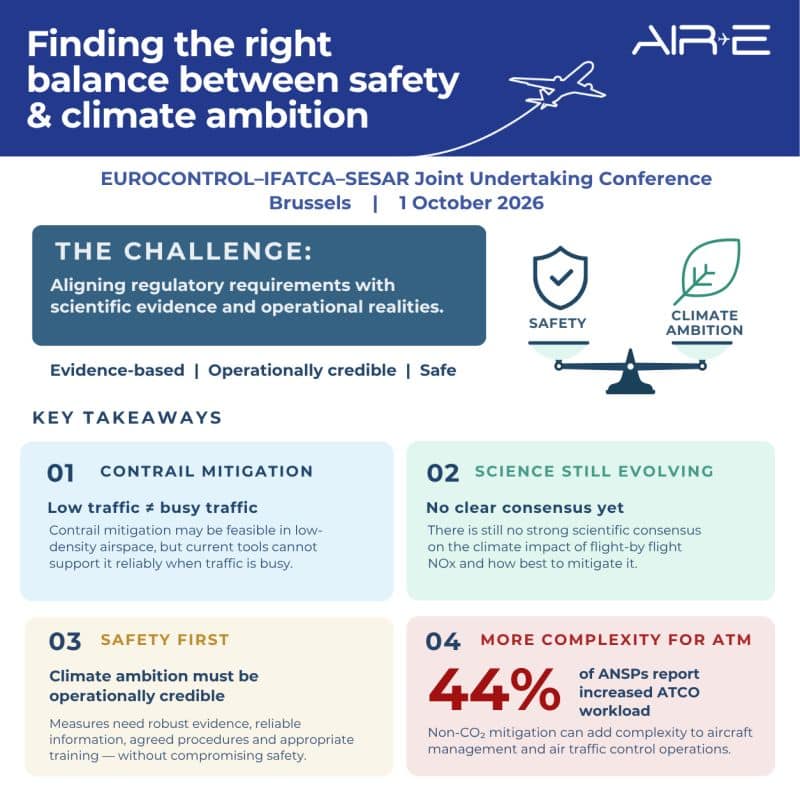
Key takeaways from the discussion
- Operational feasibility depends on traffic conditions
Contrail mitigation measures may be easier to implement in low-density traffic situations, such as during quieter periods in domestic airspace. However, as highlighted by Sian Andrews of NATS, applying these measures becomes more challenging in busier traffic conditions with current tools and operational capabilities.
- Further scientific evidence is needed
Speakers highlighted continuing scientific uncertainties surrounding the climate impacts of aviation’s non-CO₂ emissions. In particular, further research is needed to strengthen the evidence on flight-by-flight nitrogen oxide (NOx) climate impacts and the effectiveness of potential mitigation measures.
- Safety must remain the priority
Pilots and air traffic controllers emphasised the need to balance climate ambitions with operational safety. Any environmental measures introduced must be supported by reliable information, scientifically robust evidence, agreed procedures and appropriate training to ensure they can be implemented safely and consistently.
- Managing the impact on air traffic control workload
Non-CO₂ mitigation can add complexity to aircraft management and air traffic control operations. Byron Post of IFATCA highlighted the implications for air traffic management (ATM) workload, with 44% of air navigation service providers (ANSPs) reporting an increase in air traffic controller workload.
These operational considerations underline the importance of assessing the practical implications of mitigation measures across the entire aviation system.
Improving the framework for non-CO₂ monitoring
Following the first reporting year under the EU framework for monitoring and reporting aviation’s non-CO₂ effects, airlines have called for further improvements to the Non-CO₂ Emissions Tracking System (NEATS).
While the tool continues to evolve, airlines must implement new reporting requirements in a context where the scientific understanding of non-CO₂ effects is still developing. Continued improvements to the methodology and supporting tools will therefore be important to ensuring that reporting requirements remain scientifically robust and operationally workable.
Aligning climate policy with operational realities
The discussions reinforced the need for further research, reliable data and close cooperation between policymakers, scientists and aviation stakeholders. Effective non-CO₂ mitigation will depend on aligning regulatory expectations with the latest scientific evidence and the practical realities of flight operations and air traffic management.
For AIRE, aviation decarbonisation measures must be evidence-based, operationally feasible and compatible with the sector’s overriding commitment to safety. Ensuring that scientific knowledge, technological capabilities and regulatory requirements evolve together will be essential to delivering meaningful climate benefits while preserving the safety and efficiency of European aviation.