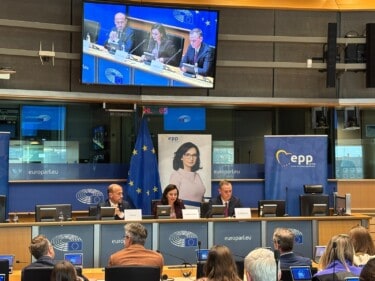
On 5 November, AIRE attended a discussion at the European Parliament on 4 November, hosted by MEPs Borys Budka and Kamila Gasiuk-Pihowicz, focusing on the upcoming revision of the EU Emissions Trading System (EU ETS) and the challenge of reconciling Europe’s climate ambitions with industrial competitiveness.
Moderated by Witold Strzelecki from Business & Science Poland, the discussion brought together policymakers and industry representatives, including MEP Peter Liese (EPP), rapporteur for the file; Wojciech Wrochna, Government Plenipotentiary for Strategic Energy Infrastructure and Secretary of State at Poland’s Ministry of Energy; Rosalinde van der Vlies from the European Commission’s DG CLIMA; and Neva Sadikoglu-Novaky from the International Air Transport Association (IATA).
The exchange highlighted the importance of ensuring that the EU ETS continues to support Europe’s decarbonisation objectives while providing businesses with the regulatory predictability and investment certainty needed to remain competitive.
Key takeaways from the discussion
Several priorities emerged from the discussions:
- A realistic and predictable regulatory framework: The upcoming EU ETS revision should support emissions reductions while taking into account the economic and operational realities faced by European industries.
- Free allowances and industry-specific considerations: Participants highlighted the importance of extending free allowances and ensuring that conditionality requirements reflect the challenges faced by energy-intensive sectors.
- A gradual emissions reduction pathway: Concerns were raised regarding the Linear Reduction Factor (LRF), with calls for a more realistic approach to emissions reductions that balances environmental ambition with industrial feasibility.
- Reinvestment of EU ETS revenues: The discussion emphasised the need to channel ETS revenues towards industrial modernisation, technological innovation and decarbonisation, helping businesses invest in the transition.
- International regulatory coherence: Particular attention was given to the importance of ensuring coherence between the EU ETS and international frameworks, including ICAO’s Carbon Offsetting and Reduction Scheme for International Aviation (CORSIA).
Supporting aviation decarbonisation and European competitiveness
For the aviation sector, the upcoming EU ETS revision represents an important opportunity to strengthen the conditions necessary for a sustainable and competitive transition.
AIRE considers that effective decarbonisation policies must be accompanied by appropriate investment incentives, regulatory predictability and measures that safeguard the competitiveness of European airlines.
In particular, ensuring that revenues generated through the EU ETS contribute to aviation decarbonisation, including the deployment of Sustainable Aviation Fuels (SAF) and other innovative technologies, will be essential to accelerating the sector’s transition.
At the same time, maintaining coherence with international mechanisms such as CORSIA remains important to avoid unnecessary regulatory fragmentation and preserve a level playing field for European operators.
AIRE remains committed to advocating for a balanced, effective and internationally coherent regulatory framework that supports aviation’s decarbonisation while safeguarding the long-term competitiveness and connectivity of Europe’s aviation sector.